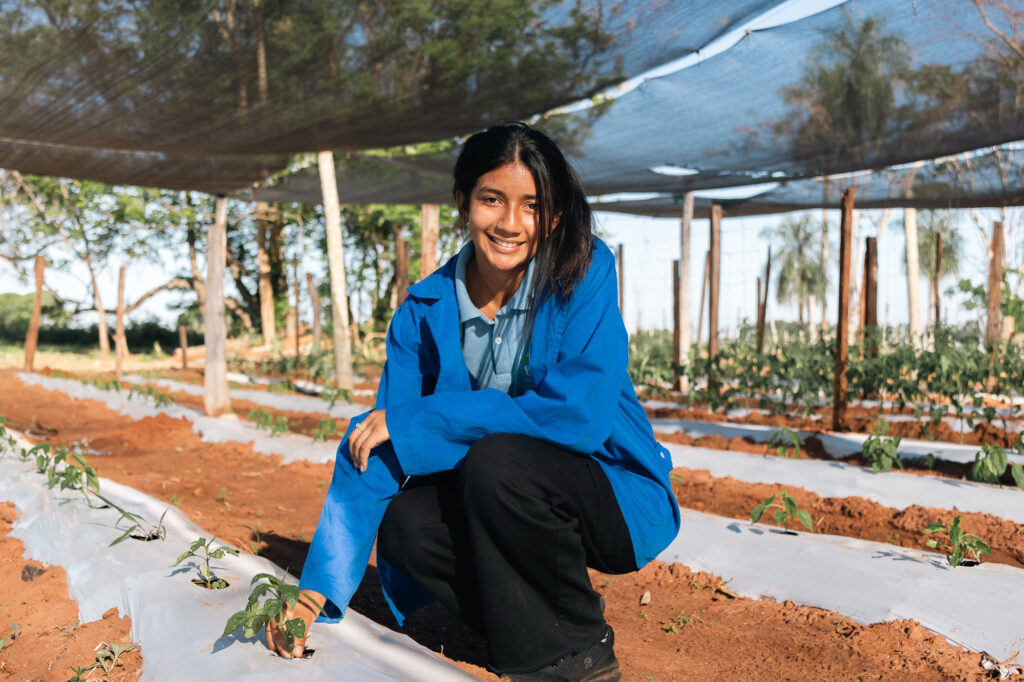
The recent situation at the agricultural school in San Pedro—marked by deteriorating infrastructure, institutional crisis, and declining production—once again highlights the structural challenges facing rural education in Paraguay. In contrast, Fundación Paraguaya’s Self-Sustainable Agricultural Schools model offers a concrete response to these issues, based on efficiency, sustainability, and entrepreneurial training.
Unlike traditional models, which often depend on limited public resources and have weak connections to the market, Self-Sustainable Agricultural Schools are built on a clear principle: “learning by doing, selling, and earning.” Implemented 23 years ago, this approach turns students into active participants in their own development, combining technical agricultural education with entrepreneurship.
Why do some schools fall into crisis?
The San Pedro case reflects a recurring reality: institutions with weak management, low productivity, and a disconnect between academic training and real opportunities in their environment. Without generating their own income or having clear incentives for production, many schools end up relying entirely on insufficient budgets, leading to gradual decline.
A model that produces, sustains, and transforms
In response to this scenario, Self-Sustainable Agricultural Schools propose a shift in paradigm. Here, students do more than just learn theory: they manage real productive units on campus, generating income that helps sustain the institution itself.
This model has been recognized by the Inter-American Development Bank and other international organizations as one of the world’s most innovative solutions for creating jobs and opportunities for rural youth.
Its main strengths include:
- Self-sustainability: schools generate their own resources through production.
- Practical training: students develop real business skills.
- Entrepreneurial focus: each graduate leaves with tools to build their own livelihood.
- Market connection: production responds to real demand.
Results that make a difference
The impact of the model is not theoretical—it is reflected in concrete results.
Currently, the methodology is present in 59 institutions across 28 countries, with more than 1,700 graduates. In Paraguay, three flagship examples demonstrate its success:
Cerrito Agricultural School:
- 115% operational self-sufficiency
- G. 4.7 billion in revenue
- G. 131 million in student business plan loans
Belén Agricultural School:
- 100% self-sufficiency
- G. 2.497 billion in revenue
- Ongoing supply of products to national markets
Mbaracayú Educational Center:
- 465 female graduates
- Training for young women—many of them Indigenous and rural—who go on to access higher education and transform their communities
More than education: a structural solution
The difference between these models lies not only in management, but in the very concept of rural education. While some systems produce graduates disconnected from the market, the self-sustainable model develops rural entrepreneurs capable of generating income, innovating, and leading their communities.
At a time when many institutions risk being forgotten, Self-Sustainable Agricultural Schools show that education can be sustainable, productive, and transformative at the same time.
Because where other models decline, this model produces, teaches, and builds a future.